2013年11月12日 星期二

批判互動設計作業06 / M10110301 / 陳柏英

hw06 / 500-word Essay

【 inTouch 】


The histories of HCI used to thrash out two major intellectual waves. One orients from engineering and human factors and concentrates on optimizing the functionality of a product; the other stems from cognitive science and lays its emphasis on theory and the mental activities of human. However, according to “The Three Paradigms of HCI” written by Steve Harrison in 2007, the third paradigm has come with the tide of fashion. Its specialty in phenomenology has made creators to think about the importance of meaning making which is mutually defining and subjects to various interpretations. Above all, instead of disproving the old two paradigms, the emersion of the third paradigm leads to a brand new choice of viewpoint to design. That is, researchers have an alternative way of viewpoint.

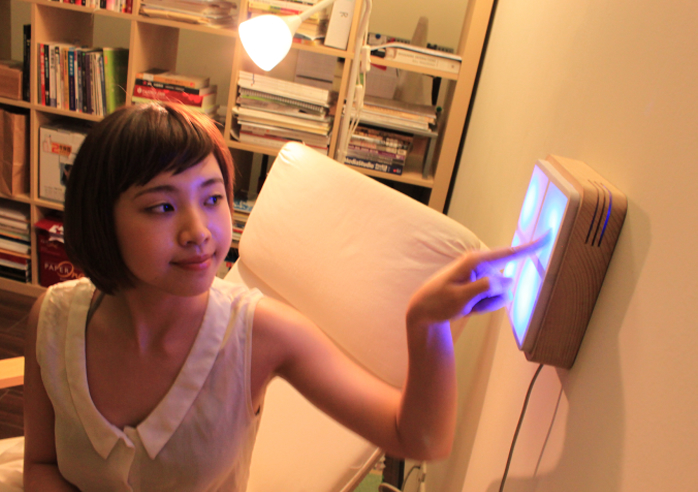
Since each paradigm in HCI is a different metaphor of interaction, we may then analyze products by different paradigms. The following case is a project named inTouch, which aims at conveying something vague but poetic such as human temperature, interactions between people and flow of time.

The purpose of inTouch focuses on perceptual crossing, ambiguity, ludic design and the implicit social meaning. Merlean argues that the whole world is a field for perception, to which we can assign meaning through human consciousness. Therefore, the perceptual crossing happens in inTouch when users see the color changes and know that it represents the contact with others since the color changes from blue to red only when users press the soft material with LED inside and trigger the button; without the touch, the color fades back to blue as time goes by. This enthralling device is mainly composed of Arduino, multi-color LED light, heat conduction material, thermoelectric cooler and the network connect to Internet. With all this stuff, the ludic value may be induced by ambiguous metaphor of interaction, and perceptual crossing also brings out the implicit social meaning.

Hence, researchers may assay products by the three paradigms we mentioned before. Take inTouch as example:

1)
The theme that underlies the first paradigm concentrates on functionality and reduction of error. inTouch, nevertheless, has little practical utility enhancing our daily lives. It only provides quite simple information of whether there is someone beside his inTouch or not. Each section represents a communication link with others.

2)
On the other hand, the second paradigm espouses cognitive science, human interaction and efficiency. We can merely infer that people is capable of knowing whether or not the person who shares his existence through inTouch is still keeping in touch with them.

3)
In contrast, meaning making is of the essence to the third paradigm. What kind of meaning inTouch makes depends on users’ own past experience. In my view, inTouch leaves a message of accompany. People are colonial animals; as a result, whenever and whatever we encounter, we tend to share this message and feeling with others. That is why twitter, facebook, and all kinds of social websites are so popular nowadays. inTouch creates great meaning on this point.

In conclusion, the three paradigms actually co-exist. However, I argue that inTouch is mainly designed to have similar intention as the third paradigm does. This artifact reflects the importance of being with people you care and appropriately display your existence even though you guys are not actually together.



批判互動設計作業06 / D10010301 / 莊偉銘

Over the past years, there have been lots of interaction design researches in HCI community. However, most researches focus on the optimizing of man-machine coupling or the accuracy of information transfer, but seldom discuss what existing situated activities in the lived world we experience. The major waves of HCI can be characterized as two paradigms. One is the 1st paradigm that cares about how to fix the specific problems and developing pragmatic solutions to them. The other one is the 2nd paradigms that focus on how to improve the efficiency of computer usage and reduce the possible ambiguity. From a 2nd paradigm point of view, design can be verified and evaluated repeatedly, and through generalizing the models researchers formulate the design knowledge. In contrast to the first two waves of HCI paradigm, the 3rd paradigm proposed by Steve Harrison in 2007 is provisionally named ‘phenomenological matrix’. As Thomas Kuhn’s theory of scientific revolution, Harrison is aware of those new paradigms that have been increasingly discussed at CHI conferences in recent years; therefore, he intends to give better voice to the 3rd paradigm. The 3rd paradigm sees the embodied interaction not only as a way of information forwarding but as a way of meaning making. Besides, new paradigm doesn’t disprove the old one,and instead, provides an alternative way of thinking in interaction design and three paradigms often coexist simultaneously. Therefore, based on paradigms introduced above, we critically discourse on the design project, ‘InTouch’, in terms of three paradigms respectively.

InTouch is a domestic artifact with four sections and each section stands for a communication link with a friend. It enables people to express their consideration to their friends through touching the tactile surface. With the color and the temperature changes, a user makes voiceless dialogue to people who also live with their InTouch. Unlike the normal digital product that we have ever used before, the inconsistence of perception might provoke user’s curiosity and uncertainty. In other words, the ambiguity of InTouch allows users to explore their own usage and feel unprecedented lived experience.


Evaluating this project by 1st paradigm objectively, it’s a creativity way to use thermal-electric cooler (TEC) as design material to deliver perception. The designer changes the intended usage of TEC and makes a working prototype. Through hacking, technology is not used for problem solving only, but a vision for better future. Likewise, the value of InTouch cannot be evaluated or analyzed by behavior sciences and statistic tools. As a result, form a 2nd paradigm point of view, according to the unstructured and ambiguous features of InTouch, the outcomes can’t be generalizable to well-defined forms of knowledge.

I argue that the designing intention of InTouch is to explore the experience of emergence and provoke feltness of experience. Further, the aim of InTouch is to provide a critique to provoke debate among paradigms through inventing an alternative way of appropriation between technology and design. On the other hand, there are epistemological differences within three paradigms and the 3rd paradigm that treats knowledge as process of meaning-making in specific context differs from the central focus of first two paradigms. To sum up, beyond the function for communication, InTouch advocates that the richness of emergency experience is as important as its social role in our lived world.

week 10. what is "critical" about critical design

What is "critical" about critical design?

2013年11月5日 星期二

批判互動設計作業04 / B9934007 / 張文韋

Gelatine is a system device aiming at encouraging coworkers to know each other more and sparking the opportunities of interaction and collaboration between them. People edit their profile information, like background, interest and skill, into the database. When they ‘’check in’’ the working place with their RFID membership card, the device will print a profile ticket about other member’s information randomly.
       With the outlook and the form, this device and visualisation makes itself like a prototype of an experiment rather than a delicate product, so user would feel be invited to try and get some fun rather than feel stressful in using. The form of ticket also implies an easy and casual using way.
            All of those physical items, like checkin Points, thermal Printer and profile ticket, suggest a different form of the digital personal information and the relationship between people. In the past form of virtual communities, like Internet forum, people turn into an ID without background and characteristic to interact with others carelessly and infinitely. On the other side, in the social networks, like Facebook, people build their real character of themselves and edit their information to interact with people they have known. However, what user didn’t except, the excessive opening personal information and excessive expansion of the scale result in privacy problem, too. Contrarily, Gelatine limits the scale of communities and brings them to the reality. Unlike Facebook, an omnipresent and transparent ‘’window’’, Gelatine plays a role of a living ‘’matchmaker’’, which exists physically and chooses the information to give independently (randomly). With the matchmaker, people know each other by ‘’introduction’’ rather than ‘’peeping’’.

In sum, Gelatine provides a new way of communities, which focuses on people have not know each other, plays a role of matchmaker and deals with the information of users more indirectly and euphemistically.

week 9. critical design & critical theory


Critical design and critical theory: the challenge of designing for provocation


http://dl.acm.org/citation.cfm?id=2318001


1. p288
   Designers' judgement vs. analysis & reasoning activity


Over the past two decades, there has been increasing interest in design in human-computer interaction. Of particular
concern is constructive design research [27], also known as
research through design [16, 18, 33, 35], where design activity in the form of constructing artifacts becomes a central
research activity. In this work, design experience in the
form of designers’ judgments is equally important to the
analysis and reasoning activities that are common to all
kinds of research.

2.
   constructive design 可以從 “想像未來" 展開, 不一定要 fieldwork, theory...


Like other kinds of research, constructive 
design research may start from the result of fieldwork, theories of human behavior, or application of a particular design
approach, but often, it can start with just imagining future 
states, and in HCI, how technology can improve the current
state of human existence.

3. critical design 的定義, by Dunne:
  吸引 viewers 進入 the world of ideas 而非 objects.


producing conceptual electronic products that encourage
complex and meaningful reflection on inhabitation of a
ubiquitous, dematerializing, and intelligent environment: a
form of social research to integrate critical aesthetic experience with everyday life…. I hope in my approach I have
retained the popular appeal of industrial design while using
it to seduce the viewer into the world of ideas rather than
objects. Industrial design locates its object in a mental
space concerned with identity, desire, and fantasy and
shaped by media.... Again, I hope this remains intact but is
subverted to challenge the aesthetic values of both consumers and designers. (p. 147)

4. p. 289


In short, critical design
proposes an approach to provocation(挑釁), rather than design as
rearranging surface features according to the latest fashion
while obfuscating (使困惑) the norms and conventions inscribed in
the designs and their use.


5.


A new
book on constructive design research details three different
approaches: Lab, Field, and Showroom [27].

...

In the  Field examples, design researchers
employ lightweight versions of social science methods to
understand the current state, and then use methods from
design practice to create new things that express a preferred
state.


 Showroom, Koskinen et al.’s term for critical
design, is different. The description in the book talks about
the theoretical influences, but does provide a sketch of how
methods might be put together to complete a project.

6. In other words,
one might desire a description of critical design as an approach to account for both (a) productsthat generate dilemmas or confusions among users in such a way that users
are encouraged to expand their interpretative horizons or
rethink cultural norms; and (b) the sorts of design processes
that could lead to those kinds of products. 

7.  p. 290

  4 種 整合 critical theory 和 design 的 困難:

(1) Critical theory offers little insight about how to make 
things.

  CT: a verbal tradition,  new theories, critiques, and insights
  D: an embodied making tradition,  design materials

(2) Critical theory tends to be anti-method.

(3) Critical theory emphasizes the meanings and effects of cultural artifacts over their creation.
(4) Critical theory generally tends not to focus on the author of  a work as an individual creative agent

critical theory 不關心 intention (of author)

But if design can be defined as intentional change [30],
critical theory’s disinterest in intention becomes a limitation
of its applicability to design.


8.
  我們已經習慣  不受限於 creators' intention


We, too, were trained to seek
to understand the effects of cultural artifacts without limiting our inquiry to what their creators intended. Likewise,
we can understand why Gaver, like Derrida before him,
rejects “method” as a description of his approach. 


9.
What we seek, then, is a middle ground between critical
design as an elitist mystery, like art itself, and critical design as a step-wise cookbook description of design practice.
We recognize that the subjective expertise of the designer is
a crucial factor that no method, approach, set of practices,
etc., can capture or simulate.

THE CRITICAL DESIGN PROCESS
10.
  先找出 挑釁的點

Among
the most basic decisions in a critical design project is identifying which aspects of the present world we wish to provoke, a process that can be enriched through an engagement
with relevant critical theory literatures.


11.  2 cases of critical design

Significant Screwdriver (SS)


As  a starting point, it seemed to us that design could be used to  transgress rather then reinforce social norms.

Whispering Wall (WW)

Another place where we might transgress rather then reinforce social norms was in the space of a health club or gym.


12.


Breakdowns in operationalizing critical theory in design
often occur because whereas theory is often descriptive,
providing frameworks or models that serve as organizing
constructs [17], design itself is actionable, creating prototypes that suggest preferred future states. As in any design
activity, in making the leap from descriptive to generative,
the designer must make judgments about how to proceed.

13.

This breakdown exposes that
in critical design, the linkage between (verbally-based) theory and the embodied design practices of decision-making
and observations of use in deployment is problematic.
Overcoming this is not something that can be derived from
critical theory resources alone (i.e., in this case, feminist
theory only got us so far), due to the fact that design as critical resource  and  textual discourses about design  are different kinds of epistemological resources. 

14. p.294

   輕微的  陌異化 是關鍵


As
Dunne and Raby write, “A slight strangeness is the key
too weird and they are instantly dismissed, not strange
enough and they’re absorbed into everyday reality…” [15,
p.63].

輕微的  陌異化  可以考量跨越 conceptual, functional, material, aesthetic 等等層面.

Our experience suggests that achieving this “slight
strangeness” is anything but straightforward, as it plays out
across conceptual, functional, material, and aesthetic dimensions of design in complex ways. Often, designers rapidly generate and iterate on solutions as a way to reason
about a problem space; when the problem space itself is
transgression and provocation, some of our more familiar
strategies will undoubtedly come up short.


15.
  how design students do vs. engineering ones:


As designers, we have considerable experience evaluating
sketches, directions, and prototypes in the context of design
briefs and situations—even ill-defined ones—both in the
studio and in the field.

16.


Provocation can be socially uncomfortable, and subjects
may not expect to be provoked when consenting to participate in a study. Researchers need to be prepared for and be
ready to handle such discomfort.


17.

Indeed, it was through conversations in which he was initiated as a peer researcher, rather than research subject, that
this participant gradually began to buy into it.

18. p. 295


Both of these patterns suggest that in a critical design study,
not only does the research destabilize the topics of inquiry,
but it also destabilizes the relationship between researchers
and research participants.


19.

In short, design researchers deploying
critical designs need to be prepared for everything to be
challenged, negotiated, and subject to fundamental change. 

20.

Critical design as a discursive methodology


Critical Design 中, 連 framing 也是 unknown:

In traditional user research, the research objective is to establish user needs and requirements. What is unknown are
relevant behaviors, attitudes, and functional needs of a target population. In critical design research, the framing itself 
is part of the unknown.


...

We were not out to discover folk theories of gender in
gyms and homes; the critical designs were meant to transgress them and provoke discussionabout that. 

21.
  重點不是收集使用者所說的話, 而是 協同思索與推思索與推論

we
didn’t just collect what they said but engaged with them
intellectually—the result was a practice of collaborative 
speculative reasoning grounded on a critical design that was
itself informed by a combination of cultural theories and
folk theories.

22.
   3 lessons from critical designs:

(1) Provocativeness
(2) Deep relationship

When using critical design in the future, we will design the
prototypes and interactions with participants with the goal
of developing a deeper relationship. We allow for repeated
and rich encounters in order to explore how participants’
insights and behaviors change as they use the design to
probe the research team’s intentions

(3) Fluidity of research plan

..., it seems that critical design
might best use theory to sensitize designers and to inspire
the intention of the provocations, but that we cannot and
should not force that theory to delimit the trajectory of the
work once it has been placed into the world. We raise this
as a concern for others who may wish to use critical design
as a way of operationalizing a theoretical framework.

2013年11月4日 星期一

批判設計作業陸/M10110302林秉毅

批判設計作業陸 M10110302/林秉毅

In Paradigm1
1.     What is its purpose and function? 
 And can we use another tool to solve this problem or achieve the purpose?
“Send our expression of consideration for our friends” are this project’s purpose.
“We need consideration from friends” or “We want to tell our friends we are not lonely” are the problem which this product solves.

2.   It is passive for users which want consideration. Sometimes you are busy. You don’t have time to search the section which is warm. And we don’t want ignore our friends consideration. There is error that we have probably impolite or disturb someone.

3.    There is a lot of wastes at this product, we don’t need so many component or material. If reduction those waste, it still can work and less error. It don’t need heater. Just have light turn on or turn off. Change the colors. Add name or image on the section can decrease the wrong touch’s error.


In Paradigm2
1.   There are too more uncertainty. When I want to know which section are warm or who concern with you, I need check four section to found the warm section. If it can change the color, I think it can more efficient. Vision is easier understanding than Touch.

2.    “As link is pressed above 5 times it color will gradually turn into red” Sometimes we probably forget how many times we touch. If we use of time that finger stay on the section, it can decrease user’s load of brain. And you can stay your finger to wait and feel the feedback.

3.      Five colors correspond five level that your consideration’s level. In general sense Cold hue let people feel freezing and lonely. In opposition Warm hue gives people happiness. semiology

4.     This product is ambient display. Maybe we will ignore it in sometimes. And we also ignore our friend’s consideration. So have alarm to remind us. It can increase feedback’s frequency and strengthen the interaction.


In Paradigm3
1.    It’s ambient display. It can’t occupy your attention. Decrease vision and voice which can easier understand. Not restrict your attention by needing faster feedback. But increase more uncertain and surprising. This randomly chance makes you feel more valuable.

2.     Poeticize the distance between two different spaces. And warm the cold machine. Instead of sending information, it passes the palm’s temperature from your friend. Just give your friend a warm hug.

3.    This project not very certainty. In general communication on network. Always one use a signal to tell the other one reply. But in this case, not as pure communication, more like a test for harmony between you and your friend. It’s more similar to the real interaction. There is not any purpose between communications. It’s a sincere friendship. It’s simple consideration but difficult emotion’s passing.