2013年11月4日 星期一

批判設計作業陸/M10110302林秉毅

批判設計作業陸 M10110302/林秉毅

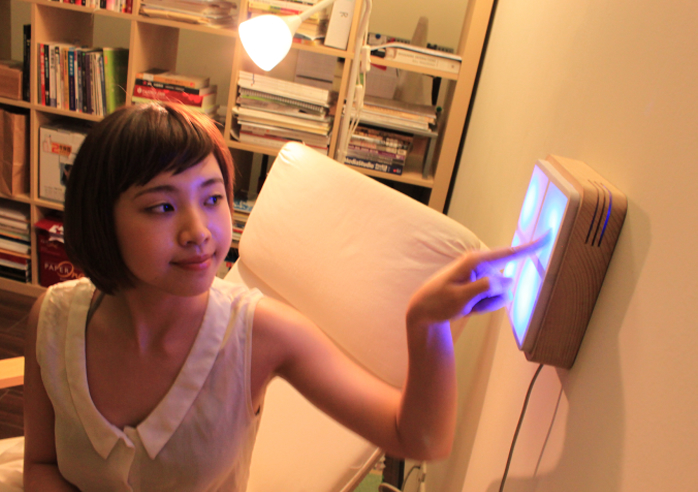
In Paradigm1
1.     What is its purpose and function? 
 And can we use another tool to solve this problem or achieve the purpose?
“Send our expression of consideration for our friends” are this project’s purpose.
“We need consideration from friends” or “We want to tell our friends we are not lonely” are the problem which this product solves.

2.   It is passive for users which want consideration. Sometimes you are busy. You don’t have time to search the section which is warm. And we don’t want ignore our friends consideration. There is error that we have probably impolite or disturb someone.

3.    There is a lot of wastes at this product, we don’t need so many component or material. If reduction those waste, it still can work and less error. It don’t need heater. Just have light turn on or turn off. Change the colors. Add name or image on the section can decrease the wrong touch’s error.


In Paradigm2
1.   There are too more uncertainty. When I want to know which section are warm or who concern with you, I need check four section to found the warm section. If it can change the color, I think it can more efficient. Vision is easier understanding than Touch.

2.    “As link is pressed above 5 times it color will gradually turn into red” Sometimes we probably forget how many times we touch. If we use of time that finger stay on the section, it can decrease user’s load of brain. And you can stay your finger to wait and feel the feedback.

3.      Five colors correspond five level that your consideration’s level. In general sense Cold hue let people feel freezing and lonely. In opposition Warm hue gives people happiness. semiology

4.     This product is ambient display. Maybe we will ignore it in sometimes. And we also ignore our friend’s consideration. So have alarm to remind us. It can increase feedback’s frequency and strengthen the interaction.


In Paradigm3
1.    It’s ambient display. It can’t occupy your attention. Decrease vision and voice which can easier understand. Not restrict your attention by needing faster feedback. But increase more uncertain and surprising. This randomly chance makes you feel more valuable.

2.     Poeticize the distance between two different spaces. And warm the cold machine. Instead of sending information, it passes the palm’s temperature from your friend. Just give your friend a warm hug.

3.    This project not very certainty. In general communication on network. Always one use a signal to tell the other one reply. But in this case, not as pure communication, more like a test for harmony between you and your friend. It’s more similar to the real interaction. There is not any purpose between communications. It’s a sincere friendship. It’s simple consideration but difficult emotion’s passing.

2013年11月2日 星期六

批判互動設計作業05 / B9910102 / 邱顯雅

Gelatine 


According to general public phenomenon, most coworkers remain unaware of and uninspired by each other's domains of interest and expertise in their public workspaces. It raises the issue of the behavioural norm among unacquainted coworkers is to work in individual silos without taking advantage of social learning or collaboration opportunities. 

The idea behind 'Gelatine' was to design a system that facilitates shared encounters between coworkers by allowing them to digitally 'check in' at a work space. In doing so, they can show their skills, areas of interest, and needs of currently present coworkers on a public screen.

The profile information is linked to their RFID membership card, which they can swipe at one of the 'checkin-points' at the entrance or specific sub locations such as individual desks or coffee  kiosk to confirm their presence in the space. A networked thermal printer randomly prints other user's profile ticket once a person touches a checkin-point with their library user card. 

The system amplified users' sense of place and awareness of other coworkers, and provide a preferred situation of social learning through helping users identify like-minded peers for follow-up face-to-face encounters. 

Unlike any other check-in device, Gelatine is not only used to record attendance, but also gives feedback that enhances first-time users' opportunity to ice-break conversations and collaborate with peers. It can also easily leverage to an information name card for the busy working people, no time to meet each other in physical spaces. But it's important to know that it's awkward to see your profile ticket was left in the trashcan in the lounge room. 

Process: The system provides an online / mobile website for users to create a personal profile with keywords (‘tags’) that describe their skills, areas of interests, as well as areas that they have a problem in or want to learn more about. It's a good way to display users' individual informations on screen in permissions, because you can decide what will be displayed of your own.

Invention: Gelatine constitute a new interaction design research contribution, producing immediate topics of conversation for people. The profile ticket result in a significant advancement in social situation.

Relevance: Based on digital era, individual information and statue are now actively shared in virtual world through Facebook, Twitter, Pluck, etc, social network website. People now use to checking a person's statue before chatting or making friends. Instead of googling someone on phones or pads, Gelatine bring this relevance from internet to real life with simplicity in material in combination with complexity of form.


Extensibility: Because it prints out the information on tickets, it can also be employed as a simple resume and move on to a short profolio with pictures of works on it. A month later, the community can even publish a paper of that month by assembling all the tickets.

2013年10月31日 星期四

批判互動設計作業03 / M10121023 /崔曉玲

Slow Technology-little printer

In this rapid changing society, sometimes we may lose our mental desire - memory, peace,and dreamland. In recent years, “LOHAS”(Lifestyles Of Health And Sustainability) life have already been the new life style in Taiwan. We want not only healthy body, but also fulfilling mental.

Although it is convenient for us to save our photos on mobile devices(smart phone, iPad and laptop), we still need to preserve our precious or memorial photos by printing out. We could paste these photos on our memos, notebooks and even everywhere in our daily life.

Here, we talk about the “Little Printer”. Little Printer is a new delightful web-connected printer to our life. It can share your details with trusted friends to receive their pictures and messages. We could also edit the forum of the pictures and put on some cute cartoons, and then print on the  strip paper.

By using Little Printer, life can be connected by slow technology and memories. Almost everyone enjoy recalling the memories or happiness by photos. Despite we can storage these photos into our computer hard disk, we still prfer to collect some of them into our album. We can always share with our parents, children and good friends.


Although we are now living in the fast growing society, everything we need very effective. But, in my opinion, slow technology is indispensable for our mental life. We could choose our life with fast or slow technology in different ways. Life with fast technology saving our time; with slow technology living with time.

2013年10月30日 星期三

批判互動設計作業05 / M10110301 / 陳柏英

hw05 / 400-word Essay

【 Gelatine – Designing for Digital Encounters in Coworking Spaces 】


Nowadays, people tend to bury themselves in work every day without noticing what others do. However, coworking spaces seek for means to assist peer collaboration. It is rather unfortunate to lose the chances to cross-pollination of skills and creativity due to the unawareness of and uninspired by others’ field.


The idea behind ‘Gelatine’ was to create a system that facilitates coworkers to share each other’s information such as skills, interests and needs of currently present coworkers by displaying on a public screen when they check-in at a workspace. Once the personal information is created on an online/mobile website, people are capable of using their RFID membership card to swipe at one of the ‘check-points’ at the entrance or other sub location.


For the purpose above, Gelatine is designed in digital devices and composed of 4 modules:

1) User Profile Website / Database / Backend
Based on Ruby on Rails, which is an open-source web framework, the website and backend system enable users to create, edit and maintain their user account and profile information.

2) Checkin Points
Checkin Point comprises an RFID reader and a microcontroller, which reads the user’s card and uploads a check-in timestamp to database.

3) Public Screen Application / Visualisation
Adopting the WordCram open-source solution for word clouds, the public screen application visualizes the shared information of users in aesthetically pleasing way.

4) Thermal Printer
Sparkfun thermal printer “listens” to the Gelatine RSS which supports PubSubHubbub (a pubsub protocol for any web accessible resources). The RSS feed contains recent checkins and provides a thermal printer with a sophisticated solution connecting to network.


Nevertheless, we may inquiry into Gelatine according to the 4 criteria of “Research Through Design as a Method for Interaction Design Research in HCI”.

As for process, Gelatine well combines digital devices and social learning in a rather simple way, and produces various unexpected effects upon users.

Furthermore, in terms of invention, the advancement in technology does result in a significant influence on Gelatine since it utilizes numerous state of the art techniques.

When talking about relevance, however, Gelatine did not mention much about the performance increase and the detail on current situation and the preferred state.

Last but not least, Gelatine potentiates interaction between unfamiliar coworkers, and makes invisible social aspects of a coworking space visible.


In conclusion, Gelatine truly broadens our horizon of how to enhance coworking efficiency with Human Computer Interaction. It aims at tracking others’ footprint, making closer relationship between unfamiliar people, and, most importantly, accelerating the co-working process.


2013年10月29日 星期二

批判互動設計作業05 / D10010301 / 莊偉銘

The Discourse on Gelatine (Drafted by Chung, Wei-Ming)

Gelatine, an artifact which is designed as a hybrid tool for facilitating shared encounters, provides co-workers with personal profile of other ones in the co-working space. Those profiles, including personal skills, interest, and working location, are randomly printed by a thermal printer for people who use the member card with RFID tag to check-in through actively touching a checkin-point at the entrance or some specific social locations. Besides, Gelatine has four modules to enable users to edit their profiles anytime and plays a social role in collaboration spaces by delivering your personal information to any other ones accidently. 


To evaluate the contribution of this artefact, we follow the research through design (RtD) approach to do research through four lens, including process, invention, relevance, and extensibility, presented by Zimmerman (2007). RtD allows interaction designers to make contributions based on their ability of materialization; furthermore, this approach stresses the artifact as research outcomes to transform the world to a better state. The process of designing Gelatine, including draft of an ambient information system, and use scenario, as described in Bilandzic’s publications are discussed in detail for future study. In addition, it provides significant inventions that provide the HCI community with guidance on how to build embodied media into a hybrid space. First, the design team generated a working prototype that integrated ‘Cozmoslab’s Profile Builder Pro’ to keep track of user’s checkin timeline. The second module is ‘checkin point’ that can identify RFID membership card through a microcontroller with connection capabilities. To aesthetically display the real-time status, the ‘visualisations’ are created in ‘Processing’ for word clouds. The final module is ‘Sparkfun thermal printer’ that fetches the RSS feed and prints out the personal profile of the most recent checkin. Therefore, in terms of the prototype they presented, interaction design researchers will see an example of how to harmoniously integrate technology into our social life. In the designing process, the design team has the sense of relevance about how design inventions enable co-workers to get cooperation opportunity implicitly. Moreover, they formulate extensibility to HCI community through documenting the literature review, interviewing the user and designing the artifact. This design research will be a significant resource for stimulating new embodied interaction in collaborative spaces in the future.


批判設計 作業伍 /M10110302林秉毅

批判設計 作業伍 /M10110302林秉毅
<Process>
Punching the clock in general process
1.      Enter office room
2.      Punch in
3.      Punch out
4.      Leave office room
This process’s purpose determines whether you are on time or not. And count the number of hour you work. Let boss knows if you are punctual or not. But in this project add one item.
5.      Produce a thermosensitive paper which record your short introduce.
Then people can get this paper not just for boss to know you. Make friend or To know someone often through the social network, introduction by himself, taking.
This item reduces uncertainty. Rise the efficiency.
<Invention>
There are sensor, user card, the Thermosensitive printer and user info database. All technique are low and familiar. Thermosensitive paper often applies to cash register and credit card terminal. Photo , ticket and fax also use thermosensitive paper.  This technique’s advantage is quick at print. It just like a note. Record something of price, name and deadline. When you come back home you can base those info to what they buy and spend. Now, change from product info to people’s background. You can pose in your notebook help you know strange colleague.
<Relevance>
When you want to know someone, you must have talk. In this conversation, there is lots of question. For example:
What is your interesting?
What is your favorite?
Where are you coming from?
We use questions to understand strange people. Sometimes we probably ask wrong question. It will make the other one angry, unhappy. We need time to carefully observe the man what you want to know. Then choose the correct question or good subjects of a talk which will come into notice. You may shy or embarrassed. But in this project, people know the other people become straight. We can know each other quickly. If you like each other is decide in the first when you got the paper.
<Extensibility>
People describe themselves by writing. Sometimes is not real. “To Know someone” or “To make friend” like consumption. This project limits people’s style because continually repeat produce. It is a cold interaction like search name on Google.

2013年10月28日 星期一

week 8. the three paradigms of HCI


The Three Paradigms of HCI
1. 1st paradigm: engineering/human factors
2. 2nd paradigm: cognitive science
3. 3rd paradigm: phenomenological matrix:
       "...addressing issues that are bad fits to prior paradigms, ranging from embodiment to situated meaning to values and social issues."

"These include participatory
design, value-sensitive design, user experience
design, ethnomethodology, embodied interaction, interaction
analysis, and critical design." (p. 2)

"a third (“3rd”) paradigm, which treats interaction not as a
form of information processing but as a form of meaning
making in which the artifact and its context at all
levels are mutually defining and subject to multiple interpretations." (p. 2)

強行將舊的 paradigm 套用到 HCI 的後果:
 "when force-fitting new insights to old paradigms
CHI fails to capitalize on the full value of these approaches." (p. 3)

 沒有清楚的認識論, 會限制 HCI 的發展:
"(3) the lack of clarity about the
epistemological distinctions between paradigms is a
limiting factor in the development of the field,..." (p. 3)

Thomas Kuhn's theory of the structure of scientific revolutions:
"A paradigm shift, then, is accompanied by a shift
in the examples which are considered to be central to
the field." (p. 3)

"In particular, Agre argues, following a long line of research
in scientific metaphor, that technical fields tend
to be structured around particular metaphors which
suggest the questions that are interesting to ask and
methods for arriving at answers to them. So, for example,
the metaphor underlying cognitive science –
that human minds are like information processors –
suggests questions it could be interesting to ask - how
humans process their input, how they represent information
internally, how they access memory, etc. - and
also suggests methods for finding answers to those
questions, for example that we can effectively model
human mental activity using computational code and
validate these models by comparing computational and
human input and output."  (p. 4)

"Following Agre, we argue that central to each paradigm
in HCI is a different metaphor of interaction. Each such
metaphor introduces ‘centers’ and ‘margins’ that drive
choices about what methods are appropriate for studying
and designing interaction and for how knowledge
claims about interaction can be validated." (p. 4)

為何 usability study 對 non-task-oriented interaction 無效?
"A fourth set of issues arises out of the domain of nontask-
oriented computing. These approaches tend to
be bad fits to the 1st and 2nd paradigms, whose methods
tend to require problems to be formalized and expressed
in terms of tasks, goals and efficiency - precisely
what non-task-oriented approaches are intended
to question. It is difficult, for example, to apply usability
studies to ambient interfaces, since standard
evaluation techniques are ‘task-focused’ in the sense of
asking users to pay attention to and evaluate the interface,
precisely what the system is devised to avoid." (p. 4)

Embodiment 在三種 paradigms 的角色:
1. In human factors, attention is paid to such factors as the fit of a mouse to the human hand or the amenability of particular font sizes to be easily read.
2. Cognitively based work in HCI has laid out physical constraints that usefully inform interface
design such as the speed at which humans are able to react in various situations.
3. Embodiment in the 3rd paradigm is based on a different, central stance drawing on phenomenology: that the way in which we come to understand the world, ourselves, and interaction derives crucially from our location in a physical and social world as embodied actors.

"A focus on embodied interaction
moves from the 2nd paradigm idea that thinking is
cognitive, abstract, and information-based to one
where thinking is also achieved through doing things in
the world, for example expression through gestures,
learning through manipulation, or thinking through
building prototypes." (p. 7)

3rd paradigm 的 中心是 現象學觀點, 而非物理的體現性:
"Despite the centrality of embodied interaction to the 3rd
paradigm, it would be a mistake to take physical embodiment
– i.e. having a body - as its central, defining
characteristic. Rather, what is central is a phenomenological
viewpoint, in which all action, interaction, and

knowledge is seen as embodied in situated human actors.
This position leads to a number of intellectual
commitments that contrast with those taken by the first
two paradigms."  (p. 7)

意義在三種 paradigms 中的角色:
"meaning, ignoring it unless it causes a problem, while
the 2nd interprets meaning in terms of information
flows. The 3rd paradigm, in contrast, sees meaning and
meaning construction as a central focus. It adopts the
stance that meaning is constructed on the fly, often
collaboratively, by people in specific contexts and
situations, and therefore that interaction itself is an
essential element in meaning construction."

3rd paradigm 的 central metaphor:
" ...whose central metaphor is interaction
as phenomenologically situated." (p. 9)

1st paradigm: reduce error
2nd paradigm: more efficiently
3rd paradigm: situated meaning-making


Different Ways of Knowing


"The three issues described previously – limited and inappropriate measures of success, acceptable methods,
and recognition of innovation – can be traced to a lack of awareness of the epistemological distinctions between the paradigms,..."

see Table 2: Epistemological distinctions between the paradigms

Objective vs. Subjective Knowledge
Generalized vs. Situated Knowledge
Information vs. Interpretation
“Clean” vs. “Messy” Formalisms


所有的 paper 都應該交代 underlying paradigms:
"We would expect that calling out the underlying paradigm
will become a standard part of every publication
in our field." (p. 17)


參考:
互動設計派典浪潮
互動設計第三派典的角色與必要性

EX 6. short essay
Critically introduce "InTouch" project with three paradigms respectively. (including 1st, 2nd, 3rd paradigms, at least 500 words in total)

Reference:


Deadline 2013/11/13